On the scene
We first caught wind of a fire breaking out in Union Street on Sunday afternoon, just an hour or so after fire services had first been called to the scene at 3.46pm. Idly scrolling on the sofa, a colleague spotted the videos posted of grey smoke billowing out of a unit by Subway. It looked like a nuisance; something central didn’t really need on a Sunday already disrupted by Old Firm shenanigans, but nothing majorly serious.
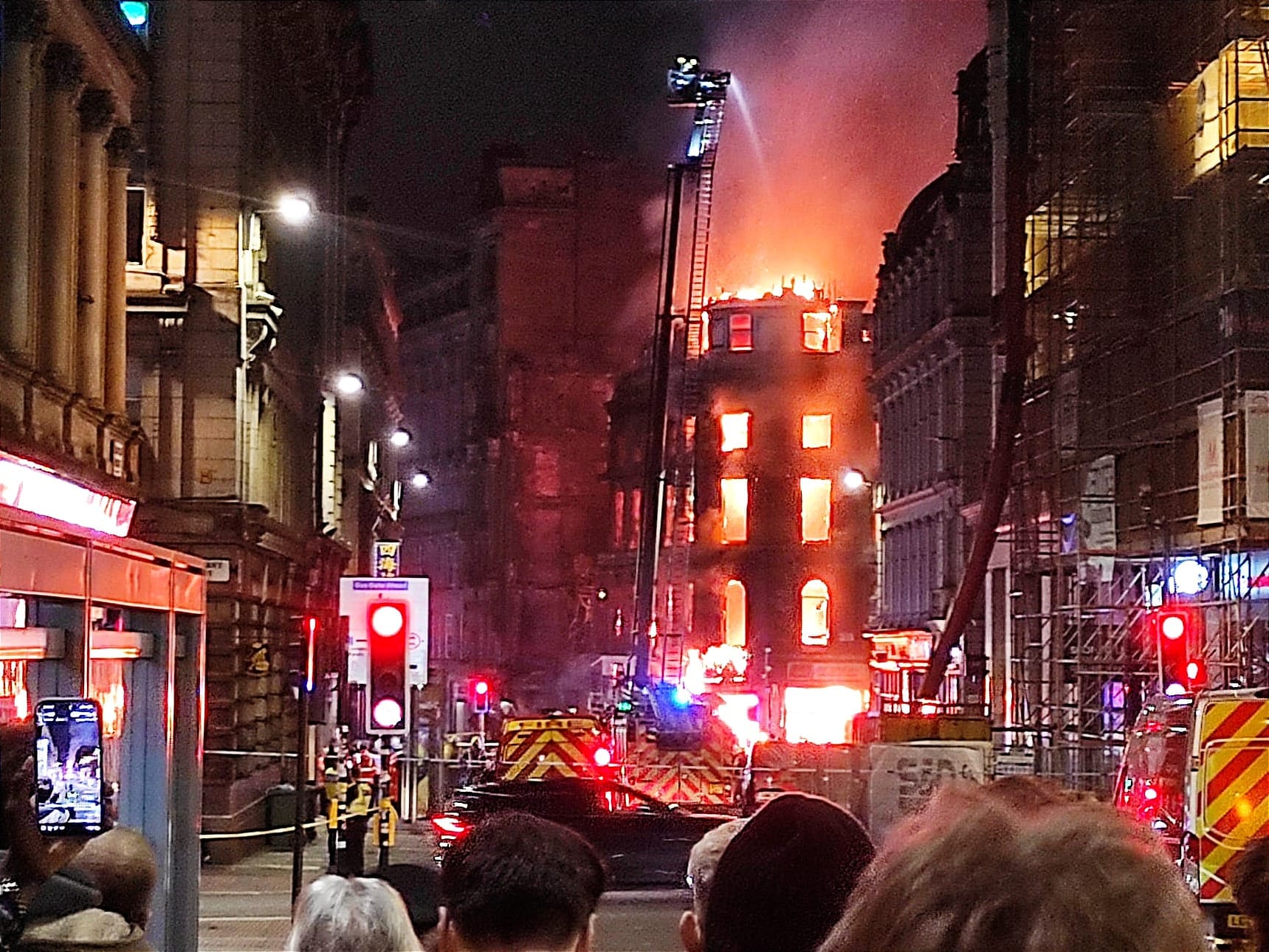
Six hours later, the nuisance had snowballed into a catastrophe. When Calum arrived on the scene at 10pm, 105 Union Street no longer existed. Between 6pm and 8pm, the fire became a raging inferno. Flames had swallowed up the building the blaze had started in; it had collapsed into rubble around 8.30pm. Now Union Corner’s famous dome was under siege.
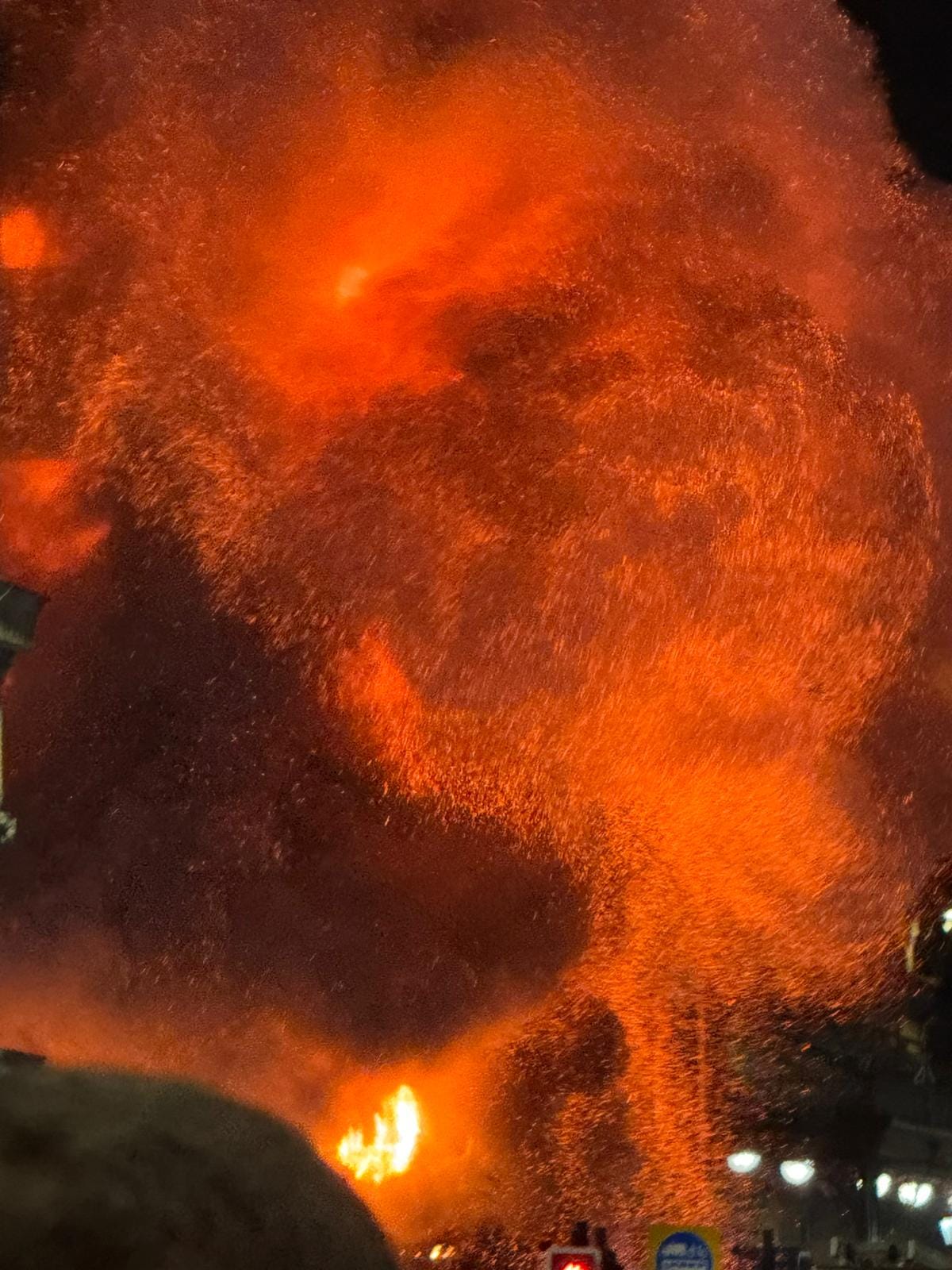
The street was packed, despite being choked with smoke. Most of the crowd were young, drawn in by the spectacle of another piece of Glasgow’s Victorian history being razed to the ground. The atmosphere was a mix of shock and awe; there were collective guttural ‘ooos’ as a fireball erupted from the ground floor of Union Corner, sending red embers up into the sky. Ash fell on nearby cars on Renfield Street. Adding to the chaos were rowdy football fans still hanging about post an Old Firm Scottish Cup quarter-finals match at Ibrox (and subsequent violent pitch invasion).
One walked past Calum shouting various anti-Celtic slurs at no one in particular. Moments later, slapping and thudding signalled the start of a fight — friendly fire, as it turned out the man had got in a scrap with another Rangers supporter. Nearby police stepped in to break it up.

From Gordon and West Nile Street’s junction, the firefighting operation was in full view. Firefighters unravelled hose after hose, unveiling hidden spouts in the pavement. Shortly before the top floor collapsed in, they’d managed to get a new hose working, hauled it up 13-metre-tall ladders, and sprayed it at Union Corner. The various side streets and blocks of Glasgow’s historic grid structure provided sanctuary for exhausted responders, and when they had to move through the crowd, it parted, Moses-like.
Liv, a Glasgow School of Art student originally from China, lives in a building just to the east of Central Station. She learned of the fire after trying, in vain, to return home. She wasn’t allowed in, for her own safety. So she had been watching the fire progress from the street since the middle of the afternoon. Waiting for her at home were the three cats and a dog shared with her girlfriend, but the couple couldn’t return until police deemed it safe (which they finally did at 2am). But Liv was only “worried about the people”, hoping “everyone escaped”. She, like the rest of the crowd, couldn’t look away from the disaster in front of her. Each moment the flames burned brought the risk of another structural collapse closer.

Although no human casualties were reported, there were already those on the scene mourning the loss of another piece of Glasgow’s architectural heritage. We bumped into Niall Murphy, director of Glasgow Heritage Trust, who’d arrived an hour after Calum. The sight of Union Corner, a building dating back to 1851, going down was “deeply depressing”, he told us. “It just shows us how fragile our heritage is”.
Online, disinformation raged too. An X post with almost 150,000 views incorrectly claimed Central Station had collapsed. Accounts also claimed both the Forsyth Building and Caledonian Chambers caught fire, but both buildings appear to be undamaged. The confusion stems from 'Forsyth House' being used to refer to Union Corner, while Forsyth Building lies opposite.
Much of the online debate and conjecture also referenced immigration and “Pakistani owners”. Blogs used AI to create completely fabricated and misleading pictures. In other posts, users asked X’s AI chatbot Grok to determine if footage was real, with Grok telling them the videos were of a fire in Tel Aviv.
By midnight in Glasgow’s conservation district, the flames were finally abating somewhat. As watchers headed to bed, the firefighters stayed, wrestling the blaze into submission. Drone shots taken of the scene at 5am show smoke still rising from the wreckage, but contained, without the feared damage to Central Station having come to pass at least.
The morning after
This morning, the scale of the fallout is only just starting to come into focus. Duncan Sweeny is one of the legions of small business owners occupying premises between 105 and 111 Union Street who have now found their livelihoods destroyed in 12 hours.
Sweeny runs the Hundred Demons tattoo studio, which was on the third floor of 111 Union Street. He was watching a comedy show at The Stand when a customer messaged him asking if his shop was ok. He Googled, not convinced at first of the scale of the fire. Surely it wasn’t that bad, it was just a vape shop.
Sweeny meandered down, hoping his studio would remain unaffected. At first, it was. But as the fire gained in ferocity, his hopes began to dwindle. “It was a torturous thing to watch”, he tells The Bell. He left at 8pm, realising which way the wind was blowing but continued to follow the fire’s “intoxicating” destructive path via a live stream. When the east facade of 111 Union Street came down, his studio went with it.
This morning, Sweeny is totting up the immediate losses: at least £18,000 worth of equipment. He hasn’t got contents insurance, so has set up a GoFundMe, along with neighbouring studios — it’s raised over £11,000 as of midday today. Sweeny is stoic when discussing his material losses but he breaks when he talks about the “amazing” support from the “tattooing community”. “It was a wonderful studio”, he said, voice cracking. “You could see the original, hand-rolled windows’. His crowdfunding operation is one of dozens now appearing in the wake of the blaze — that stretch of Union Street was chock full of independent beauty, hospitality and arts tenants.
Cycling into work this morning, Calum could smell the smoke from as far away as Garscube Road. Nearer to the source, commuters were stopping to snap photos of the remnants of last night’s devastation: the tottering, surviving north face of Union Corner and a couple of hoses propped up on ladders, still dutifully pouring water into the ruins of a Glasgow landmark.
Last June, we published our 'Tinderbox City' map, which tracks fires historic, non-residential buildings that have been badly damaged by fires since 2000. We hoped it would be a useful resource for many Glaswegians — and that we wouldn't have to update it as regularly as we have.
After yesterday's Union Corner fire, the current tally stands at (least) 42 historic buildings impacted by fires in Glasgow in the last 26 years. Please read the article, and make use of it. It's a public resource.
What we know
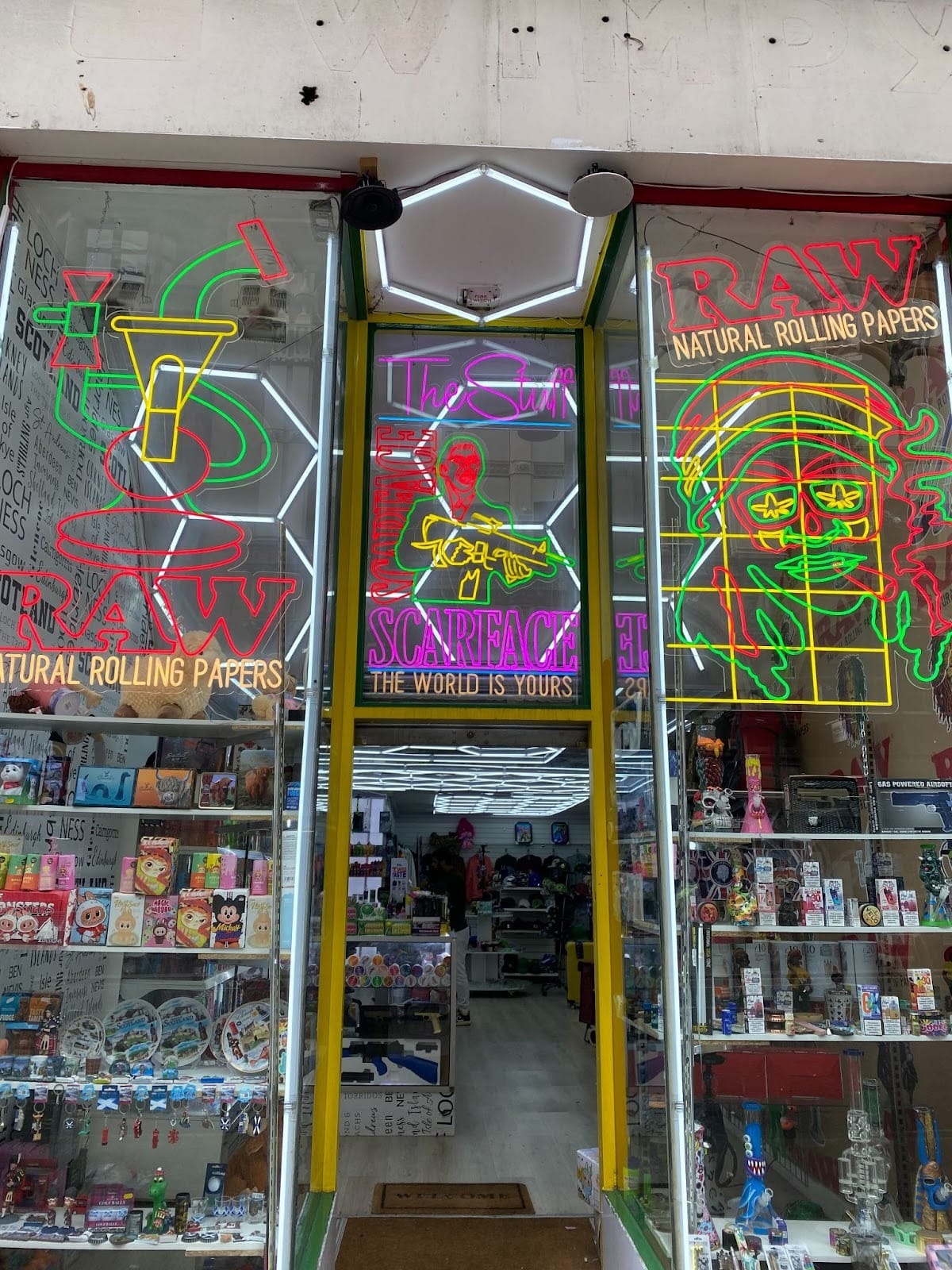
The fire started at 105 Union Street — various reports have the tenant of the ground floor as a ‘vape shop’, as briefed by Network Rail. By coincidence, the Bell photographed this shop in August 2025 — it had only opened within the last 15 months, as it was empty in June 2024.
Our picture reveals a business that appears to be more of a “head shop”, selling not only vapes but bongs, rolling papers, BB guns, Labubu dolls and clothing, alongside general tat. Shelves of disposable and refillable vapes are visible in our shot.
Compounding questions around the origin, firefighters this morning wouldn’t confirm to us that the vape shop was where the fire first started. The BBC spoke to Lamin Kongira, a eyewitness. He was walking past the shop when the owner exited, shouting “fire, fire”. Kongira entered, and claims he saw a “small fire under the counter," located in an adapter charging system full of chargers.
As our picture shows, the shop also contained a large amount of disposable vapes. Stephen Mackenzie, a fire safety consultant, describes the type of fire that could have started it all as “self-sustaining”, due to lithium-ion batteries, commonly found in disposable vapes, which burn “until all their energy is used up”.
During such fires, “thermal runaway” occurs, and flame jets and explosions are common. Because they are practically impossible to extinguish, if the fire did take hold in the ground floor unit at 105 Union Street, Mackenzie believes that from an early stage, the fire service could only try to contain the blaze. The fact Glasgow Central appears to be largely unharmed is a major achievement.
“There were enough firefighters, enough kit, but the construction and age [of the building] meant the odds were stacked against them”, Mackenzie tells The Bell. According to Mackenzie, the combination of a potential lithium fire with a 175-year-old building, riddled with voids and upward shafts, meant the fire just had to be let to “burn out” at Union Corner — which it did within six hours.
Inquiries are already turning to responsibility — and ownership. The Bell can reveal that the destroyed B-listed Union Corner building — originally built in 1851 for stationery entrepreneurs, the Orrs — is mostly owned by Dunaskin Properties, a company registered in Guernsey. Their Glasgow portfolio is extensive, including other heritage buildings such as Baltic and Central Chambers, and Ingram House. Looking after this property collection is Stelmain Ltd, who manage one million sq ft of retail and office space, mainly in Glasgow's business district.
Stelmain was established over 50 years ago and is owned by Manchester/Glasgow based Harvey Freeman. The Stelmain/Dunaskin Properties connection is strong and overlapping — Dunaskin Properties’ main beneficial owner is a man called Alan Freeman — now 86-years-old — and both Stelmain and Dunaskin have a registered address in Tel Aviv.
However, the ground floor unit at 105 Union Street, where it looks like the fire originated, appears to have a separate owner: as reported by the Daily Mail, the Edinburgh-based property company Afton Estates Ltd bought the unit in 2008 and still owned it as of 2024. Afton Estates directors are Michael and Kenna Tasker. Michael Tasker is also a director of the Royal Forth Yacht Club, founded at Granton Harbour in 1868.
What we don’t know
A lot. But The Bell is already elbow-deep in this story. We’ll be working around the clock to understand why and how this happened. And we’d massively appreciate your help with the effort. If you have any information on the building, the occupants or those associated with Union Corner, please email editor@glasgowbell.co.uk today.
What happens now?
Glasgow Central remains closed for travel today while the council carries out a safety assessment about when it’s safe to reopen. First minister John Swinney has arrived on the scene, after a morning announcement that the Scottish Government will offer financial assistance to Glasgow city council. Fire expert Mackenzie tells The Bell that Network Rail will have been assessing timelines and damage from as early as last night (this morning we saw scores of Network Rail staff entering and exiting the cordon). The police cordon has now been extended as a precautionary measure, in case of a gas leak from a damaged building. The new cordon stretches up Renfield Street towards West George, as well as part of St Vincent Street, reports the BBC.
The next steps will be for the forensic fire investigators to try to determine the cause. If it is found to have been vapes, expect calls to ban such shops in heritage and residential buildings. Swinney is already being grilled about the issue; at his Gordon Street press conference, the first minister said he was “open-minded” about the issues around vape shops, adding that the government will look at all questions raised by the fire “to make sure we come to the right conclusions”.
If someone forwarded you this newsletter, click here to sign up to get quality local journalism in your inbox.