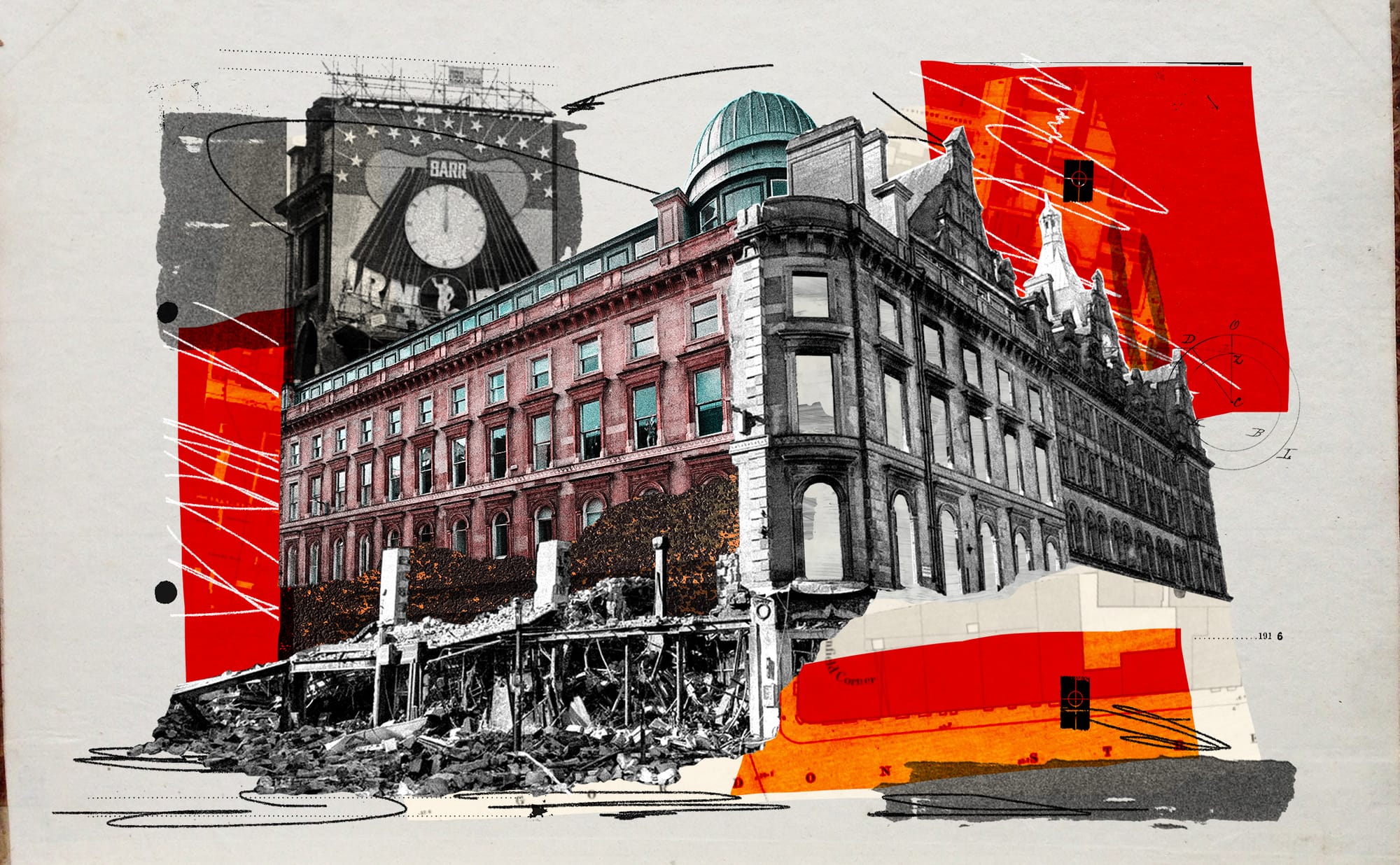
In the aftermath of the fire that destroyed a key part of Union Street, one question prevailed. Perhaps it was best summed up by Scott McGready, posting on X.
“Right,” McGready wrote. “Who the fuck has ever called it ‘the union corner?”
He wasn’t alone.
“I’ve lived in Glasgow almost 60 year and have never once heard it called Union Corner,” someone else wrote. “Nobody. Ever. [called it Union Corner]. Until now. Woke fucks,” proclaimed another. One user shared a Bell article saying, “Wtf is ‘Union Corner’? Honestly man, these people aren’t Glaswegian.” Others labelled it a “mainstream media confection of dubious purpose”.
Publicly, the jury’s still out. The media still alternates between ‘Forsyth House’ and ‘Union Corner’. Politicians like Glasgow’s built heritage guru, Paul Sweeney and the secretary of state for Scotland initially went for the ‘Forsyth Building’ — but were promptly corrected on social media.
So who’s right? Or, are they all wrong?
Was it ever called anything?
Milling about Gordon Street on a Wednesday afternoon, five weeks after the blaze, unwitting tourists lug suitcases towards the cordon that still blocks off the demolition zone at Union and Gordon Street, where cranes pick away at charred brick. Many others wander down the street to gawp at the gapsite, a new melancholic tourist destination for the city centre.
A serious looking man in a shirt and gilet reluctantly stops to chat on his way back to the office. He’s been working in the Ca’ d’Oro — famously rebuilt after a devastating 1987 fire — for 12 years. In that time, he’s never heard the building referred to as anything specifically, other than perhaps Union Corner, although even then he sounds uncertain. Has recent coverage invented a retrospective memory in the minds of Glaswegians?
Although the former department store — rather demure in its neo-claccisist edifice and minimal ornamentation — occupied a central place in the city’s built fabric, streetscape and history, its name eludes even its most elderly residents. Mary Sutherland, an 89-year old retired bus conductor with bright eyes and a big smile, is being pushed through town in a wheelchair by her daughter. She “watched with horror” as the building burned down. As far as a name goes, she’s far more interested in bemoaning the demise of the city centre, and besides, she has no memory of ever calling it anything.
Three sisters, Belle, Trish and Betty Glen, have come to look at the remains after a birthday afternoon tea at the Mackintosh Tearooms. Betty, the middle sister, has just turned 73. The trio are three of 15 sisters. “The Irn Bru building,” Betty and Belle shout when asked what they called it, referring to the old Barr’s Irn Bru sign that used to stare out up Renfield Street, later replaced by a clock, then an illuminated advertising board.
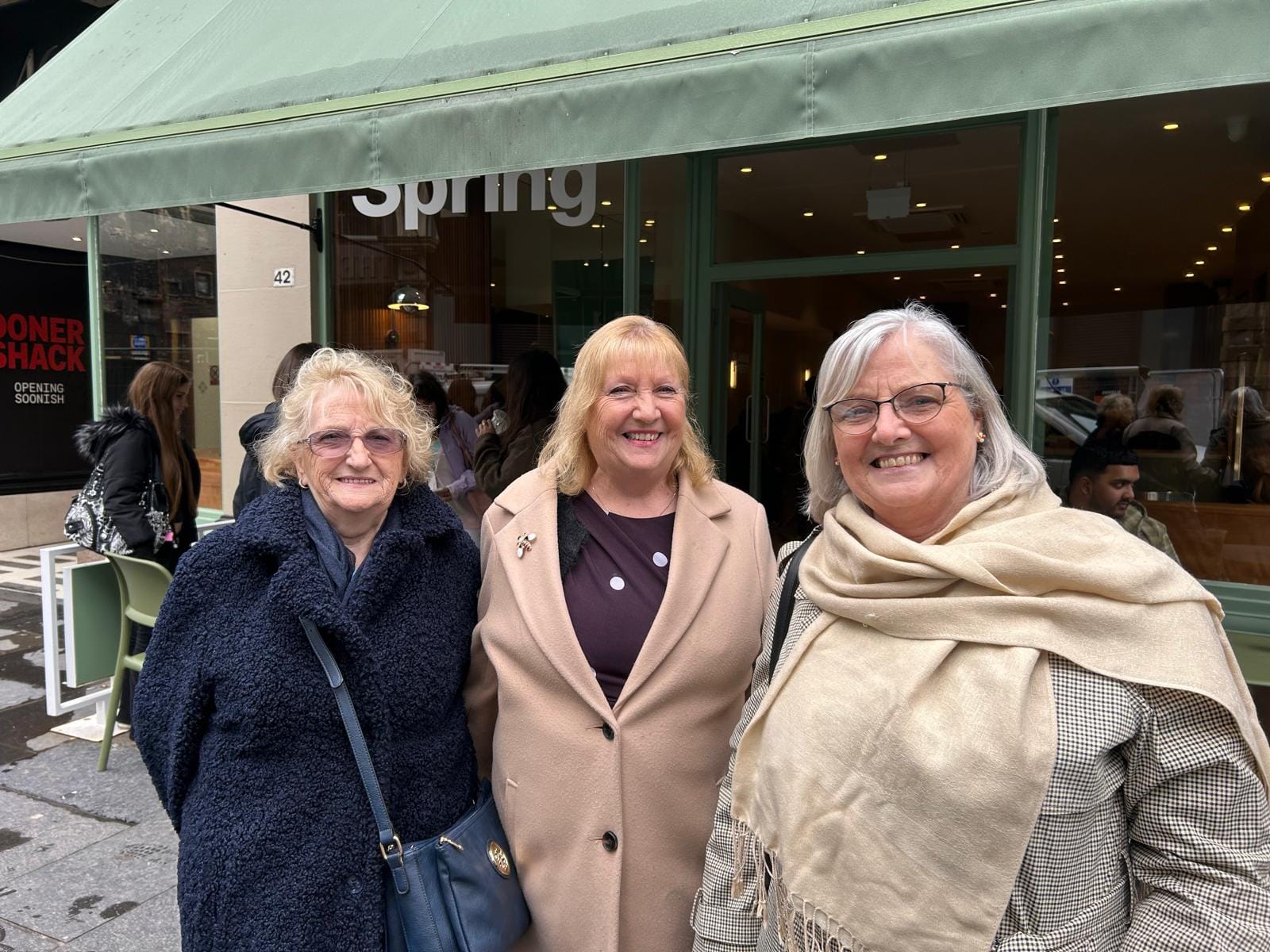
“Ba Bru, the wee black boy,” Belle whispers. “He was wearing a turban and drinking Irn Bru.” She’s referring to the neon advertisement, which would now comfortably be described as a racist Indian caricature, that loomed above the building until it was replaced in 1983.
“It never had a name,” says a man in his mid-60s standing behind the cordon, staring morosely at the remains. “It was just ‘Union corner’,” he says with a sigh.
What's in a map?
Some of the confusion stems from publicly available maps. As flames consumed the Victorian B-listed building at 101–115 Union Street, journalists and politicians turned to official records to try and find a name for it. Historic Environment Scotland had one, attributed to an Ordnance Survey map: ‘Forsyth House’, a name also used by a number of businesses registered at the address. Yet combing through old maps, online records and archives, one finds no mention of Forsyth House.

Hi, Robbie here. To find out truly, once and for all, the name we should be calling the building that burned down, you'll need to become a paid subscriber. And why wouldn't you? We're in the process of bringing quality local journalism back to Glasgow. By signing up, you can read all we'll ever publish, as well as access our extensive back catalogue of investigations, features, and award-winning stories.
If you take out an annual membership, you get two months free. You can also join monthly, so why not give it a go?
This story is free to read. You just need to sign up to join The Bell's mailing list. And why wouldn't you? You'll get our journalism in your inbox the second we publish, keeping up-to-date on this and all our stories. No card details required.
Already have an account? Sign In