Over the past eighteen months, Glasgow’s remaining traditional newsrooms have quietly undergone their most radical transformation since the death of hot metal typesetting … AI “co-pilots” are no longer just proofreading text; they are actively scraping council minutes, writing up traffic reports, and generating thousands of words of daily neighborhood news. How did a city that once defined the sharp, cynical edge of British journalism become a testing ground for automated copy?
In case you didn’t already realise, that was written by AI. The spelling of “neighbourhood” might have given it away. It’s sleek copy, sure, if soulless and formulaic (though the question at the end is a good one).
Using a chatbot to write articles is a sackable offence here at Bell HQ. But elsewhere it’s oozing in. Newsquest, which owns the Glasgow Times, the Herald, the National, the Glasgow Wrap, as well as local titles like the Clydebank Post, Dumbarton Reporter, Renfrewshire Gazette and Barrhead News, has an entire “AI-Assisted Reporter initiative”, employing 36 AI-assisted reporters across its titles. The UK’s second biggest regional news publisher argues that the use of AI “frees” its journalists from ‘churnalism’, giving reporters the time for “high-impact reporting that matters to readers and communities”. I’m not so sure.
When Newsquest first rolled out the scheme, it was possible, if not easy, to tell which Glasgow Times stories were published with AI assistance (you had to click through on the writers’ name to read their bio). Today, all mention of AI is gone. But the newspaper, it turns out, isn’t very good at covering its tracks.
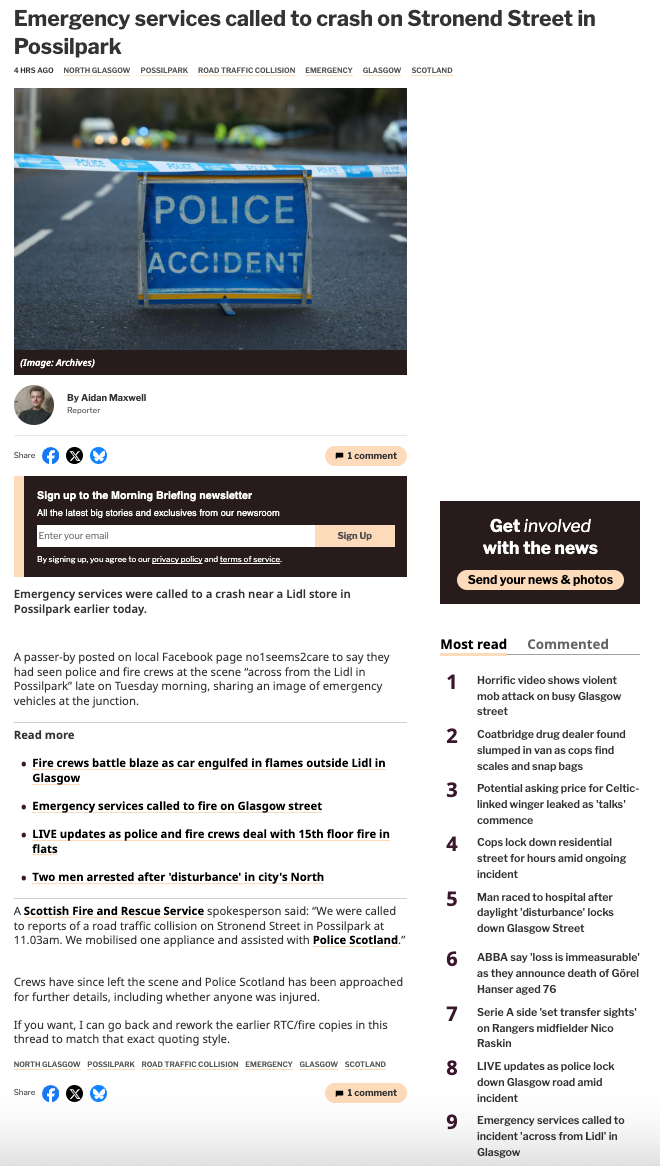
This week, I was reading one of their articles, about a car crash in Possilpark. “Crews have since left the scene and Police Scotland has been approached for further details, including whether anyone was injured,” the piece signs off. But then there’s a little addendum: “If you want, I can go back and rework the earlier RTC/fire copies in this thread to match that exact quoting style”. While the article has since been updated, we kept the receipts.
Look, this isn’t a potshot at time-pressured journalists. The Bell team has been in the trenches, we know what it’s like to be writing articles at a clip. We reserve our ire for Newsquest and its owner, USA Today (the conglomerate formerly known as Gannett). Across Newsquest’s 200-odd titles, they produce something like 9,000 stories a month using AI-assisted reporters. And at the same time, they’ve been cutting journalism jobs over several years.
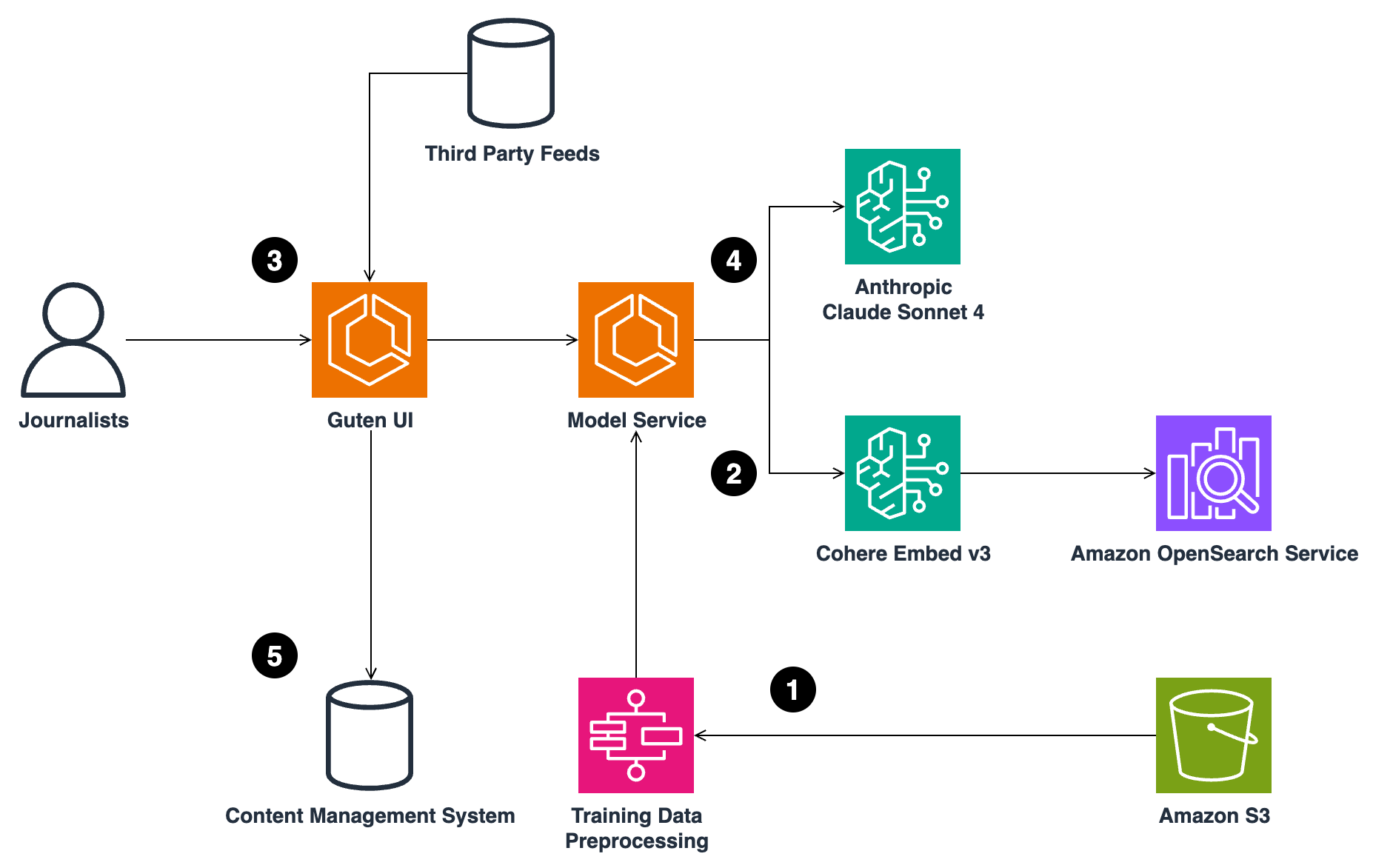
They’re not the only ones. At the UK’s largest regional news publisher, Reach (owner of the Daily Record, Glasgow Live, the Airdrie & Coatbridge Advertiser, Hamilton Advertiser, East Kilbride News, Rutherglen Reformer and the Wishaw Press) it’s a similar story. They use a system called Guten to rip stories from other Reach publications, tweaking the copy slightly to adapt to the house style and avoid detection. And you’d be none the wiser; there’s no disclaimer, no acknowledgement whatsoever about the use of AI — nicht so gut.
Lewis James, senior data scientist at Reach and Dan Taffler, director of data and analytics, wrote a blog in which they boasted that “Guten optimises every part of Reach’s editorial workflow including ingestion of news wires, wire article suggestions, article idea recommendations, and content generation.” It’s that last one you should be particularly worried about. “Content”, which we still insist on calling “news”, is being generated by AI. The authors write proudly that Guten has significantly increased the release speed of breaking news, “reducing time to publish from 9 minutes to 90 seconds”.
Here’s the key point: AI is already writing your local news. This isn’t just about facts or accuracy, though AI is notorious for hallucinating. It’s about people — the journalists who make the news and the humans who read it.
Here at The Bell, we believe humanity is important. To do the type of reporting we do week in, week out, requires boots on the ground. It requires hours of research and days, if not weeks of reporting. And we don’t just pay our journalists properly, we pay illustrators, photographers and editors.
It also makes for much better reporting. This week my colleague Beth went down to Fernhill school to speak to devastated parents, children and staff, following its liquidation. AI can’t have those sensitive conversations, it can’t be on the scene. And it can’t channel those emotions into a piece that captures just what has gone so wrong here.
 Beth Templeton
We set up The Bell in 2024 because we believe our city deserves great journalism. Because we care about what happens here, and what type of stories are told about Glasgow. We’ve not even been going for two years, and we’ve just hired our third reporter. We’d love to hire another one day, to cover our city in greater depth.
Here’s the rub though. AI is cheap to use. Very cheap. Humans, on the other hand, are expensive. They’re gallus enough to ask for a decent wage and to take holidays and time off. If you want to read real stories about our city — not clickbait, slop and content fodder — then you need to pay for the real people who write those stories.
The future of news is being decided right now. If people aren’t willing to pay for human journalists, this thing only goes in one direction: more and more AI, gradually eating itself. The market will give people what they demonstrate they want, and if that’s dirt-cheap journalism, that’s exactly what they’ll get.
The only way we stop that future is if people like you step up and say: yes, I’ll pay a little bit a month to back real journalism by real journalists. I think that matters, and I’m not just going to say it, I’m going to make a positive change to achieve it.
That’s why I’m asking you to join us today: to support real local news, written by real local people.