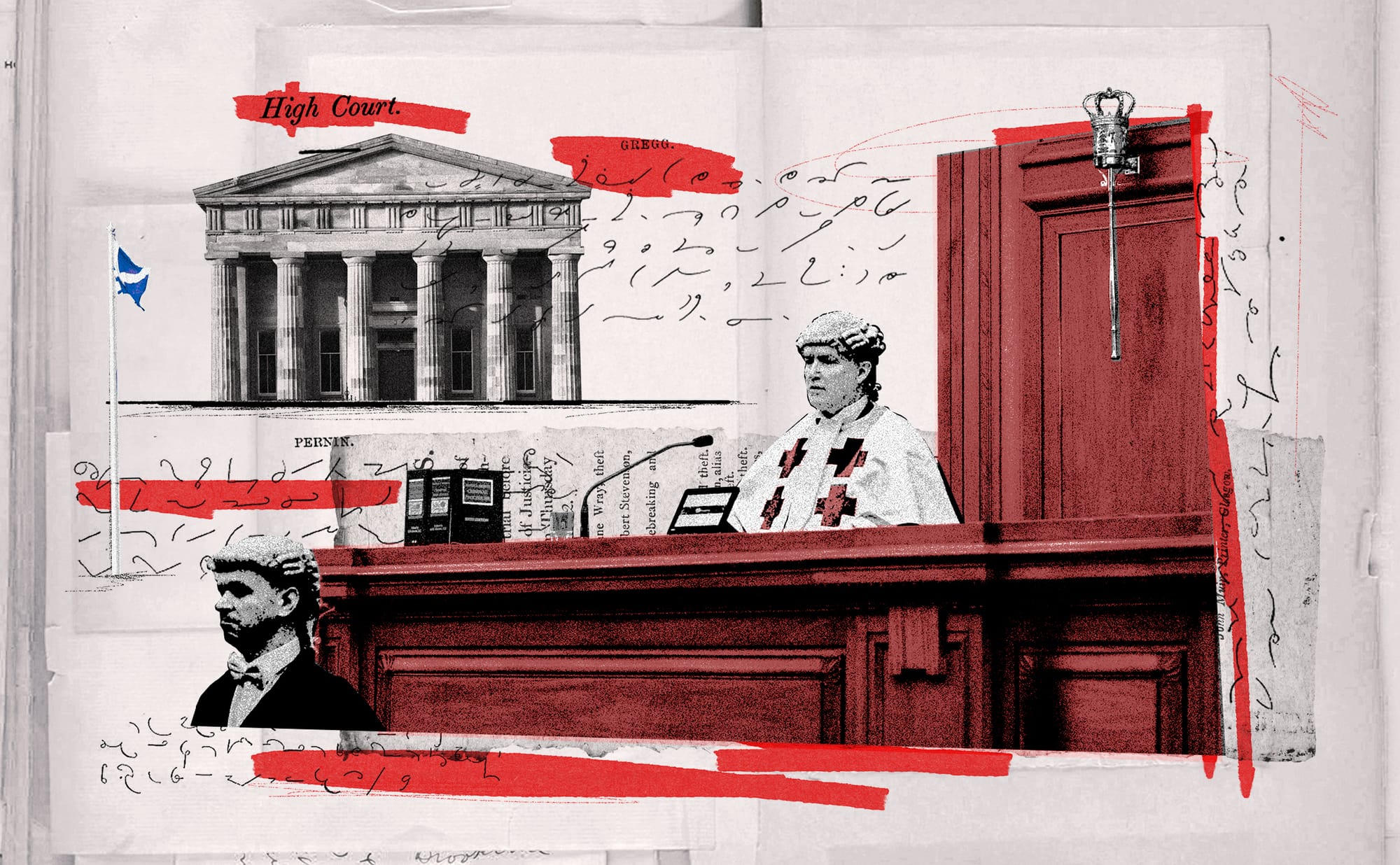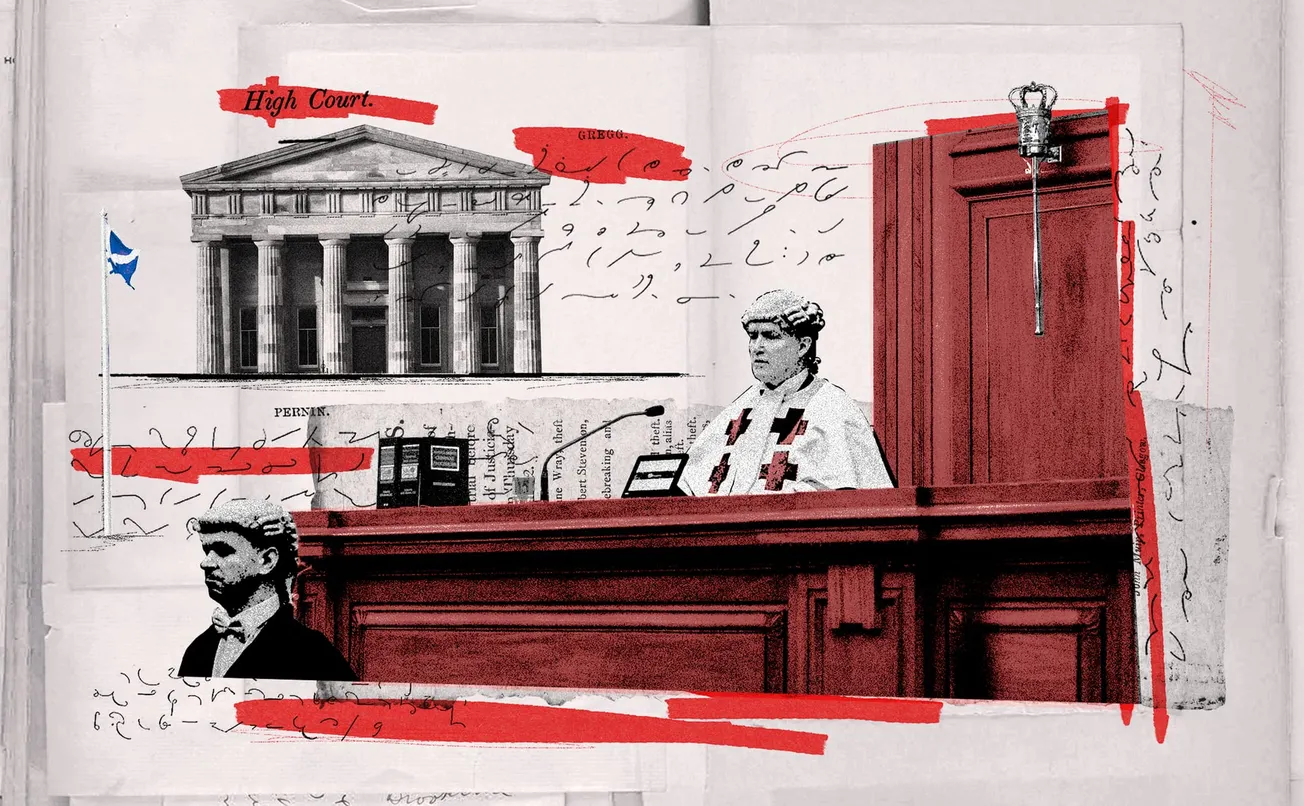
It’s a drizzly Tuesday morning at Glasgow’s High Court of Justiciary. On the docket are cases befitting its status as Scotland’s supreme criminal court: a murder sentencing, the start of a high-profile youth murder trial, and a serious organised crime group in the dock for money laundering and drug trafficking. The real drama, though, is happening outside on Mart Street.
The security guards are on alert, focussed on a guy in his forties in a white shirt causing a stir on the street. “He’s been fighting with the polis,” one of them says. By the time two police officers usher the man through the security gates, it’s immediately apparent he’s pished. Seriously pished. He staggers through the scanner, leans on a table and slurs something inaudible, grinning widely at the onlookers. Then he kicks off one shoe, almost tripping up one of the security guards.
“The High Court is normally more sophisticated,” Connor Gordon says, struggling to hide his amusement. In contrast, his usual patch, the Sheriff Court, which handles the vast majority of local civil and criminal cases: “is just a bunch of neds”.
Gordon’s a surviving member of an ailing but storied journalistic discipline: the court reporter. He works for the Glasgow Courts Press Agency, which has been providing court reports to national and local newspapers since the mid-1970s, day in, day out. It’s now the last agency covering the city’s two main courts. Today, it’s led by Grant McCabe, who joined in 2002 as a reporter, becoming a partner in 2008. He’s Gordon’s lone colleague, and boss.

Together, the pair are the city’s final two full-time court reporters. Alongside a few others, like the dogged Digger magazine and PA Media correspondents, McCabe and Gordon are responsible for a lion’s share of the court coverage coming out of the city, after years of cuts to specialists at Glasgow’s various newspapers.
Gordon joined in 2019, straight out of college. “Seven years too long,” he says. “My big boy job.” McCabe appears out of nowhere, in a light blue quarter zip with eyes to match, and a notepad tucked under his arm. Gordon is wearing a grey shirt, black trousers and shiny shoes. He’s still boyish, with neat hair and a well-trimmed beard. Both are conspicuously inconspicuous, as if their fits are tailor made to draw no more than the requisite approval of the courtroom, but otherwise to blend smoothly into the background.
A photographer walks in off the street excitably. “The white shirt guy was scrapping with someone, then trying to kiss everyone, including his lawyer,” he explains. “If you’re going to the jail for ten year, ye may as well have one last blow out,” Gordon replies.
McCabe explains the white shirt man is in the dock for a money laundering case. “Gangster stuff”, he says. “Unless yer man sobers up, they’ll probably remand him and kick him on ‘til tomorrow.”
“Oor rivals are here,” Gordon says, spotting the PA reporters arriving to cover the Irvine beach murder case.
From clerks to cleaners
McCabe and Gordon seem to know everyone at Glasgow’s two premier courts. Security guards, police, solicitors, cleaners, court clerks. McCabe calmly catches the latter as they walk between cases, gleaning information about delays, start times and the intricacies of each case. This is hard currency in his business, the difference between arriving half an hour early or half an hour too late. And here, on court time, it’s rare that anything starts when it ought to. “My mate and the court have something in common, they’re both always 20 minutes late,” Gordon jokes.
Here, at the High Court, it’s easy enough to work out when a case is about to happen across its nine courts, for McCabe at least. The Sheriff Court, meanwhile, is capable of accommodating up to 3,000 people a day across its 23 courtrooms. It’s reputedly the busiest district court in Europe, though it jostles with Hamburg for that ignominious title. The fortress-like building contains Justice of the Peace courts as well as courtrooms dedicated solely to drugs and domestic abuse. “The Sheriff Court to some people is just a way of life,” McCabe says. “Folk will bring their wee yin to see the other half in court. It’s sad when you see that, but that’s just life.” Usually, the Sheriff Court is Gordon’s domain, while McCabe tends to cover the High Court, which lies diagonally across the Clyde.
Today, Gordon is over at the High Court to cover the start of the Kayden Moy murder trial, which has gripped Scotland, freeing up McCabe to take on the rest of the day’s business. McCabe darts off to speak to a prosecutor he sees walking along a corridor up the stairs. “No much is gonnae happen today,” he says on his return. He explains that Cole Turley, the 18 year-old accused of Moy’s murder in Irvine last year, pled guilty yesterday. The case against the two remaining accused is likely to take weeks. Today the 15 members of the jury are being sworn in; it’s unlikely any evidence will be heard before court adjourns for the day.

At the High Court, the stories are “no very cheery”, McCabe explains. “Everything from murder, death by drink driving, grim abuse cases. You’re there effectively to sell a story to the wider media.” At the Sheriff Court they look for stories that are “more quirky or a bit light-hearted”. He cites the case of the Still Game actor who went tonto in a road rage incident, or the man who attacked Balamory’s PC Plum with a snooker cue. Positively upbeat for a seasoned court reporter.
Blind leading the blind
The pair bounce along to the Scottish Courts and Tribunal Service media office, which acts not only as their office but the press room for all journalists covering court that day, making it a cramped affair with reporters from STV, BBC and PA here for the Moy trial. The Sheriff Court office is windowless, which puts it at a disadvantage to the High Court office, which has a window overlooking the Saltmarket. There are piles of notepads and rubberbands, a Monet print and a fan for hot days. The atmosphere is a bit frenetic, as reporters scramble for the information they need to cover the case. McCabe floats above it, proffering information here and there so people know what’s going on. Still, he holds enough back to ensure he and Gordon have the edge.
“I’m helpful but I’m no helpful,” McCabe explains later with a smile. “I’m there to help as much as possible, but I’ve got a job to do, it’s my business. If I can get a headstart, I will.” The tannoy announces another hearing and everyone shoots off in one direction or another.
In this instance, the man in the white shirt is in the dock. McCabe walks into the south courtroom armed only with his notepad and disposable pen. The solicitor describes his client as “intoxicated” and the situation “regrettable”. “Stocious more like”, McCabe mutters under his breath. The judge adjourns the case until tomorrow. The accused rises and stumbles downstairs to a cell. We’re back again before long, to hear the case of the second accused, named as William Pollock. The man is brought into court, glancing assuredly at his family and friends in the public gallery.

Robbie and Calum here. As this piece makes clear, local journalism has been cut to the bone by media mogul owners, multinationals and megacorps in recent years. There are no news barons at The Bell, just a threadbare team on a mission to bring back proper reporting.
If you aren’t quite ready to become a fully-fledged Bell member, sign up to our mailing list and get two totally free editions of The Bell every week: a Monday briefing, full of everything you need to know about that’s going on in the city; and an in-depth weekend piece.
This story is free to read. You just need to sign up to join The Bell's mailing list. And why wouldn't you? You'll get our journalism in your inbox the second we publish, keeping up-to-date on this and all our stories. No card details required.
Already have an account? Sign In