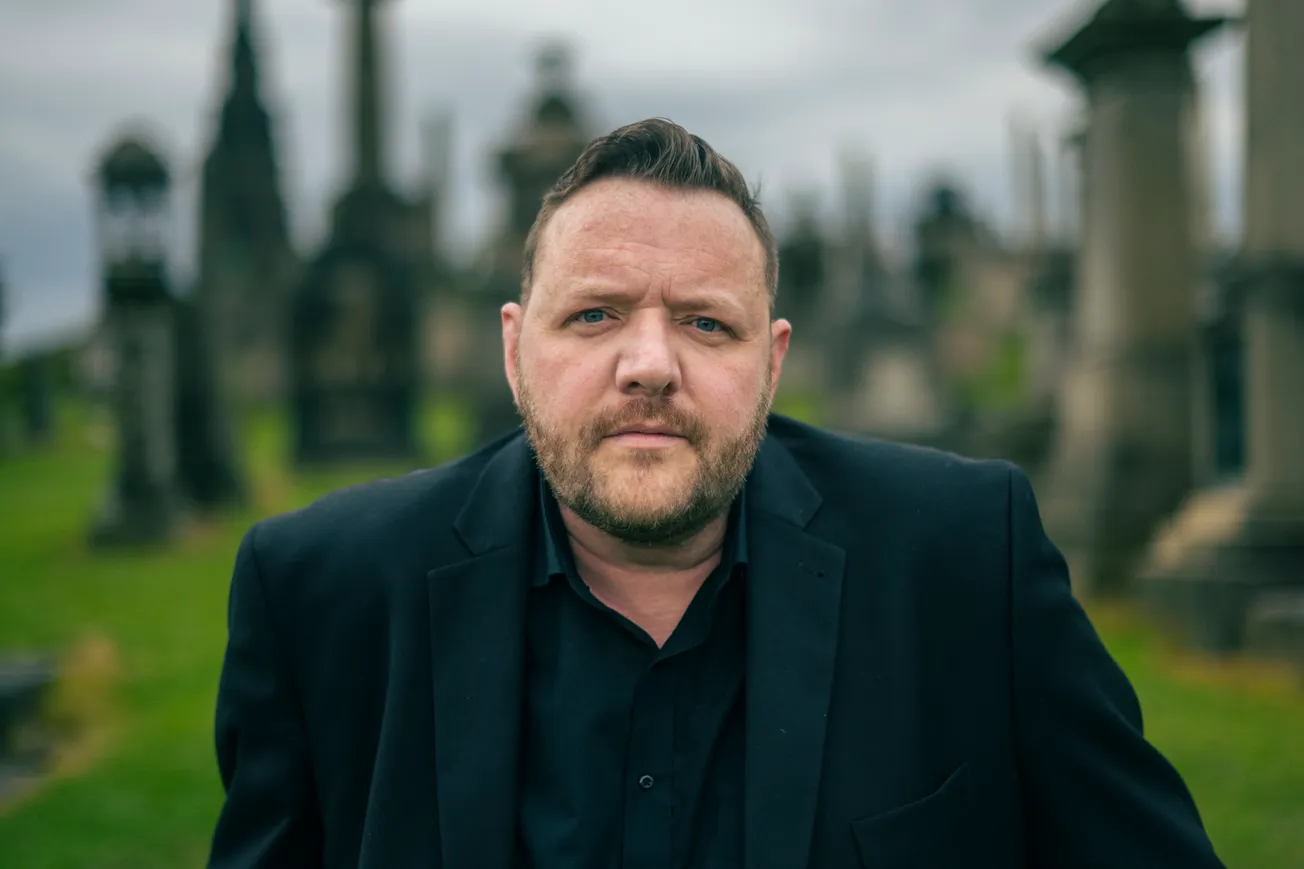
It’s September 2021, just another day for two paramedics at the Royal Infirmary’s A&E. But they’ve got their work cut out for them. There’s a 6’5, 22-stone comedian in the back of their ambulance, and he won’t stop going into cardiac arrest.
An hour earlier, Scott Agnew was parked in front of the TV, hoping the weird breathless feeling he’d been experiencing all day would clear. The 40 year-old has only just emerged from 10 days of quarantine; he’d caught Covid-19 on his first night out in Merchant City to celebrate pubs and clubs being able to open into the wee hours once more. Some rules are still in place but: “trying tae socially distance fucking 50 homosexuals fae one another was not happening,” Agnew deadpans, in his gravelly baritone.
After more than a week holed up at home, today he’s finally ready to venture out of his Saltmarket flat. Yet he feels iffy. Several pints and two cigarettes haven’t relieved his laboured breathing. Neither has the comedy special he’s stuck on after struggling back home. So he’s done what any middle-aged man who lives alone would do: called his mum. Before she rushes him to A&E, he sneaks another fag; he has a feeling it might be his final one for a while.
Sixty minutes later, Scott Agnew is being jolted awake. “‘Fucking hell big man, that was a beezer, I’m gonnae have tae keep my eye on you’,” says one of the paramedics.
“Are we at the Jubilee?” Agnew mumbles. The other paramedic in the ambulance, a woman who met him at the Infirmary, had calmly explained that he would be transferred to the Golden Jubilee, stat. It turns out he’s having a massive heart attack.
“We didn't manage to get you out the car park,” comes the reply. He’s gone into cardiac arrest and been revived. Not to worry; they’ll try again. Except Agnew’s overworked little organ, which has survived years of smoking, chronic meth addiction and HIV, has decided it needs a rest. Maybe forever.
Ye died, did ye aye?
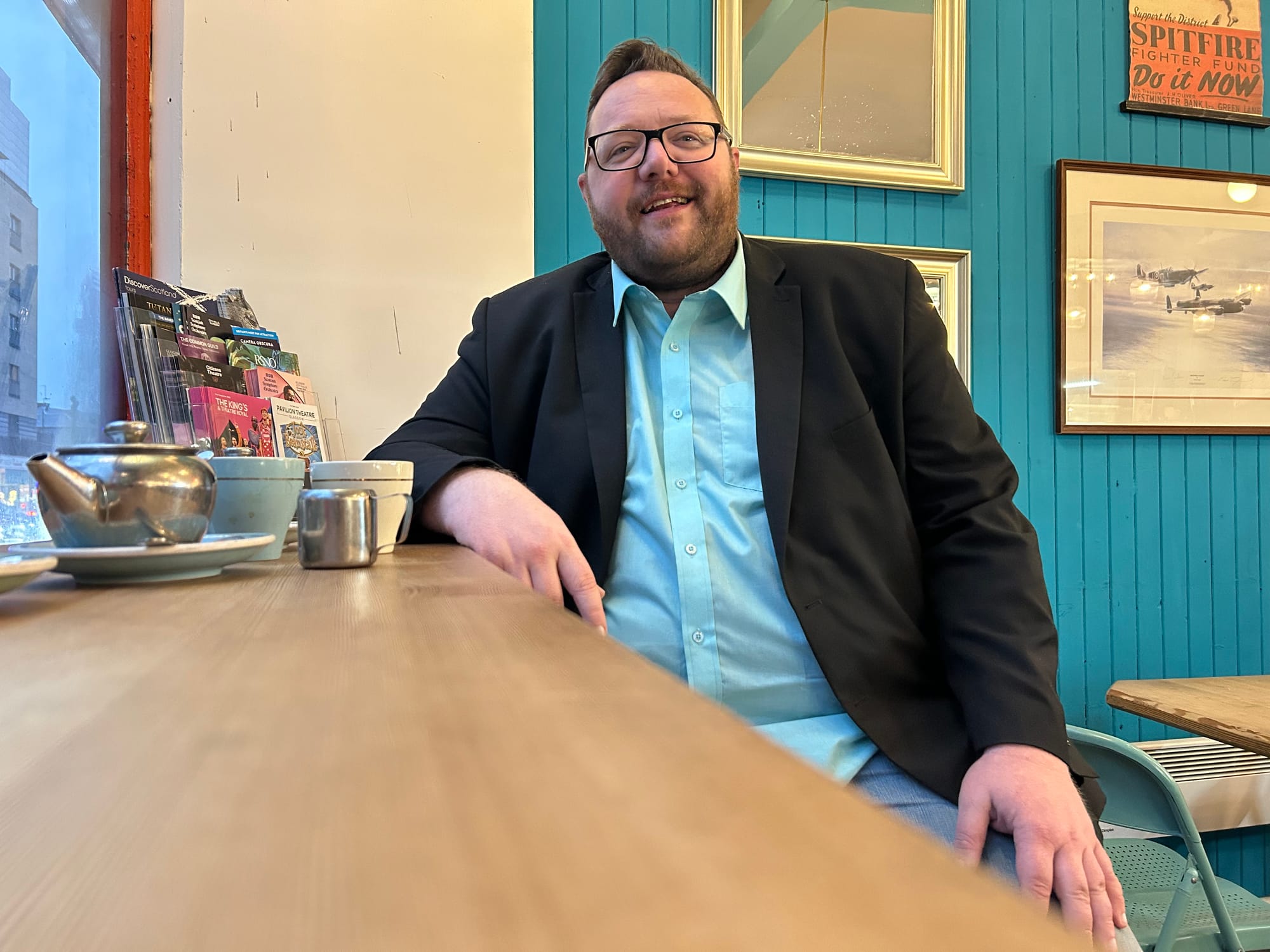
It takes two more cardiac arrests and a treacherous nine-mile journey before Scott Agnew is finally rushed into the Golden Jubilee operating theatre. “That was my kind of party trick. When I got in the ambulance, I would die on them,” he says dryly, nursing a turquoise mug in a High Street coffee shop. He’s no stranger to a miraculous comeback, not just physically. He’s reached the top of Scottish comedy, hit rock bottom more than once, and clawed it all back.
At the Jubilee, doctors stabilised him; scans revealed a massive 5cm block on his artery. Agnew watched from the gurney as a surgeon crafted him a custom stent to clear the obstruction. The average stent size is 1.5mm — Agnew’s needed to be 50mm.
He followed the surgeon’s clever, careful hands in amazement, smelling the glue. After the stent is fitted, they use an inflated balloon to open the artery, at which point: “I genuinely felt as if I could have got up and walked out.”
Thanks for reading about the wild highs and worrying lows of Scott Agnew. This is what makes The Bell Glasgow's most unique newspaper. Where else do you get deep dives into why Glasgow's incredible water is under threat one week, and features about chemsex and comebacks the next?
These are just two of our (award-winning, might we add), weekend reads. And you can get them completely free of charge, every Saturday when you click the button below, plus a bonus Monday briefing, full of the most important news happening in your city. No one is else doing what we are. Join Glasgow's journalism renaissance today.
In reality, he’s had three blasts of the defibrillator, and is in no fit state. But Agnew is “literally buzzing” at his triple resurrection. “I didn’t sleep for the next two nights,” he says, disbelievingly. “The good old fucking Glasgow cliché, having your first heart attack at 40.”
The unreformed reformer
Scott Agnew was born in Rottenrow Maternity Hospital on 12 November 1980. The day after, private homosexual acts between consenting adults in Scotland were finally decriminalised. The significance of the date only took on meaning to him later.
“I was brought up Catholic,” Agnew explains, weighing each word. “Most people roughly my age have been told gay sex is wrong, you can’t do that, you’re going to hell an’ aw that.” Amid the terror of the AIDs epidemic, it was also normal to be told “sex is death”. Societal and internalised homophobia dogged Agnew for decades. He sees it as a factor in his later troubles. “It’s not an excuse, but it is a reason,” he says reflectively.
Agnew wasn’t meant to be a comic, let alone a celebrated one. In 2000, he was six years into a journalism career, working at the Rutherglen Reformer, when an assignment took him a different route. Des Clarke, an old friend from his days at Holyrood Secondary School, had reached the final of So You Think You’re Funny, an annual competition for new stand-up comics. Agnew was tasked with profiling him. To add colour, his editor suggested he have a go on stage too.
Dressed in a Hawaiian shirt and armed with some material on Rolf Harris’s Animal Hospital, Agnew made his debut in a dark basement bar, and was immediately hooked on the buzz he got from the audience’s laughter. A second appearance on stage the following week saw him die on his arse but it didn’t matter. He’d found a new high.
Comedy became the outlet to exorcise his darker vices. Despite his steady job, and new foray into stand-up, Agnew’s early twenties were chaotic. He was “drowning out the white noise of life with chemsex parties, drugs and alcohol”, a method that “wasn’t working”. Between the ages of 23 and 25, he calculates he’d had at least 100 sexual partners. Aged 25, he tried to take his own life.
Then came comedy and a steady rise. By 2008, Agnew had won the Scottish Comedian of the Year award. Thus began a trend in Agnew’s life, of remarkable highs and lows. Later, he would receive a diagnosis that helped make sense of the pattern. But for now, all he knew was an upswing — until suddenly, another downward spiral.
Scott, meet Tina
Despite his escapist habits, Agnew’s career didn’t begin to suffer properly until 2012. This is also the year his heart begins closing up. The booze and fags aren’t doing it any favours but it’s the crystal meth that really takes its toll. The comedian has been introduced to the drug via chemsex (for the uninitiated, chemsex is the intentional use of drugs to enhance, facilitate, or prolong sexual experiences, and is primarily — but not exclusively — associated with gay and bisexual men).
He still has fond memories of those early days, the “really small sense of community ... 10–15 guys starting to look after one another”. But, “like any good gangster movie, it all starts to fray and all starts to fall apart”. At 32, a near-daily meth habit takes hold, followed by everything that addiction brings, plus clogged-up arteries. “Clearly it wasn’t doing anything very good for you,” he says, understatedly.
At first, Agnew maintains the facade of a successful, if chaotic comedian. His 2012 Fringe show, ‘Tales of the Sauna’, takes him across Europe. What follows is four years of chemsex parties, from Prague to London. But then: “all the work dried up, because I was fucking out my bin”.
At one point, in the throes of addiction, Agnew more or less vanishes for two years, taking more drugs and having riskier sex. After a particularly messy night, he assumes he’s now HIV-positive, so decides to exclusively sleep with HIV-positive men. It’s not until he’s in love that he finally brings himself to get tested.
Agnew’s partner is HIV positive and on medication, so can’t transmit. Agnew regularly accompanies him to the squat Brownlee Centre on Great Western Road, a dedicated clinic for people living with HIV. Repeated exposure to the Brownlee makes Agnew reflect on his repeated exposure to the virus. He wants to know for sure.
To his utter astonishment, Agnew tests negative, but the nurse has a warning: carry on as he is and he’ll test positive “within 18 months”. Agnew ignores her. His partner is diligent — there’s no risk. “It’s like Alan Cumming in Golden Eye, you’re like, ‘I am iiiiin-vince-eeeble’,” he says with a dark laugh.
Then, in 2015, comes the crunch point. In 2016, when Agnew first began publicly sharing the story of how he contracted HIV, it sounds a little different to the one he tells today. “I contracted HIV in my own living room at a time when I wasn’t promiscuous at all. Not at a party, not in a sauna, just in my house with one partner,” he told the BBC at the time.
This is the story Agnew tells today. It’s a Monday morning. He and his partner are jangling something chronic, at the tail end of a weekend bender. They’re out of drugs and looking for more. Someone pops up on Grindr — they’ve got the goods. Threesome? “We were fucking greedy, desperate, because you’re fucking addicted at this point,” Agnew says, his voice growing tenser by the second, as he squirms in his seat.
The lads go over. The man they’re meeting is HIV positive, but unlike Agnew’s partner, he isn’t on treatment. He assumes Agnew is HIV positive too. He isn’t before he goes to their house. He is when he leaves.
In 2015, Agnew receives another diagnosis — he’s been living with cyclothymia, a form of bipolar disorder. It explains much about the highs and lows he’s been enduring since his early twenties. Around this time, he starts to receive mental health support and psychodynamic therapy. Armed with new coping mechanisms, and better able to understand his own psyche, he finally starts to break his addictions.
There’s a lot to unpack and only one thing for it: a classic Agnew comeback. Within 12 months, he’s back at the Fringe, this time sober, performing ‘I’ve Snapped My Banjo String, Let’s Just Talk’ — a show “less about HIV” than about “mental health” and “homophobia”. Five star reviews follow, one hailing the show as “autobiographical, explicit comedy at its pinnacle”. The national newspapers start to take notice. He becomes a regular panellist on the BBC show Breaking the News, hosted by his old pal Des Clarke.
After getting clean, Agnew gets a one-bed flat on the Saltmarket. When his friend Janey Godley sees the state of it — bare floorboards, terrible paint job — she sets about organising a whip-round with the stand-up community, many of whom then come round to do up the flat together in support. “I felt very loved,” says Agnew. “It helped enormously with my accountability because it’s easy to break promises to one person, but hard to break them to the whole Scottish comedy industry when they’ve all looked you in the eye… Even people I didnae like have been very nice to me,” he laughs.
Pure mince
Then came the heart attack. The aftermath demanded lifelong commitments: quit the fags, stay clean and work on his mental health. Things haven’t been easy. “I’m now four or five stone heavier than I was when I had the heart attack,” he says. He can’t exercise — extended tendonitis in his foot — and suffers from depression, so has put on more weight. Because of the drugs, he has no testosterone, no vitamin B12, no vitamin D. “I’ve fucked my body, there’s no two ways about it.”
But for a comic, such experience is golden material. A year after escaping death, Agnew is back on stage again, like he never left. Afterwards, he’s standing at the bar with two pals. A guy comes over and asks to speak to him. ‘Can you wait a minute?’ Agnew replies, curtly.
The guy isn’t having any of it. He grabs Agnew’s hand, and says in his ear, “That was a beezer big man, I’m gonnae have tae keep an eye on you.”
Agnew is stunned. “Fuck! Was that you?”. He nods, and points to a woman watching them intently: his wife, who turns out to be the other paramedic. The couple had found Agnew thanks to his own ambulance self-promo. “You were fucking plugging your gigs and offering your Twitter handle,” the paramedic tells him.
“That [moment] was weird, nice, emotional,” Agnew says, remembering.
Today, Agnew is still at the mercy of the vicissitudes of life. He’s gentle, reflective and kind. But also twitchy, restless. There’s a lingering sense of regret lurking there, a feeling that perhaps he could’ve been one of the greats of Scottish comedy, had his life not turned out the way it did. He’s not that tech savvy, and feels his knack for storytelling doesn’t translate well in the era of shortform social media clips. But he’s not finished yet.
In 2024, he made a BBC radio series, ‘Dead Man Talking’, “telling the story of how he died and the musings over mortality that have dominated his life”. He’s currently co-hosting a podcast, ‘Matters of the Heart, and other Failures’, about heart health, with former SNP advisor Nathan Sparling, with regular episodes in spite of Sparling’s legal troubles. Later this year, Agnew brings his new show, ‘Pure Mince’, to the Glasgow International Comedy Festival. “Scotland’s only zombie comedian regales you with further tales of battling back from the dead — stayin’ alive isn’t as easy as you’d think,” quips the flyer.
In truth, Agnew is at a low ebb. A string of deaths have rocked him: his beloved support worker, Paula McCabe, whom he met at a HIV charity, died in November 2023. This was followed by Godley in 2024, whose passing is still clearly raw, despite several hilarious stories he shares about her. Gary Little, another comedian who helped him when he needed it most, died last year. And 2026 began with the death of Christopher “The Ram” Broomfield, who had become a father figure to Agnew, aged 69.
The glut of grief has left Agnew “exposed and vulnerable” as he mourns. It’s been 10 years since his HIV diagnosis and recovery. “I’ve lost a lot of people from around that time that helped me get off drugs,” he says. This time though, he’s not going back to his old ways. “It’s been a grim three or four years,” he writes in a message, “but we honour them by going on”.

While you're recovering from that belter, why not sign up for free to make sure you can read more stories like Scott's in the future?
If someone forwarded you this newsletter, click here to sign up to get quality local journalism in your inbox.